
The International Medical Device Regulators Forum (IMDRF) have published a document entitled IMDRF terminologies for categorized Adverse Event Reporting (AER): terms, terminology structure and codes. The purpose of this document is to aid in harmonization of adverse event reporting by use of codes that have been generated. They aim to facilitate the adverse event reporting of four main areas:
- Problems from the Medical device point of view.
- Problem from the Components point of view.
- Observations of the patient (symptoms and health impact).
- Investigations (type of investigation, findings, and conclusions).
Manufacturers selling in the EU should be aware that Competent Authorities are now requiring the addition of these codes for vigilance reporting within the Manufacturer’s Incident Report (MIR) form. In recent presentations by EU Notified Bodies, they have consistently informed clients of the importance of these IMDRF AER codes. Although they do not show as mandatory entries on the EU vigilance forms, their interpretation is that the codes do actually need to be provided. Furthermore, Notified Bodies have stressed the importance of these codes moving forward, and therefore we encourage all manufacturers to begin to adopt this coding system in their reports and quality management system.
This article shall provide you with the information necessary to understand the coding structure and how to implement it.
Key Benefits
There are various foreseeable advantages when using a harmonised coding system:
- For manufacturers, the main advantage is the consistency that can be achieved with regards to reports made in multiple jurisdictions. In essence it brings down any barrier of communication that ever existed within the European Union and globally. This will help them reduce the need to learn multiple different coding systems to comply with different jurisdictions all over the world.
- In the case of medical emergencies, time is of the essence, thus using a system like this will help enable a faster local and overseas response to further protect the consumer and end users of the device in question.
- Lastly, for regulatory authorities, it will provide common terms and definitions and therefore will help facilitate the analysis of safety, quality and performance in a fashion that can be readily shared in a global setting.
The Annexes
The ‘IMDRF terminologies for categorized Adverse Event Reporting (AER): terms, terminology structure and codes’ provides a total of seven different annexes which are listed below;
| Annex | Description | Structure |
| A | Terms and codes for describing Medical Device Problems. These could have occurred in the pre- or post- market contexts. | A[00][00][00] |
| Annexes B-D [Cause Investigation Terms] Describe the type of investigation being carried out, along with the findings and conclusions. | ||
| B | Terms and codes that describe the type of investigation that the device is subject to. Terms go into detail on the type of testing performed as well as methods referred to as non-testing methods such as interviews. | B[00] |
| C | Terms and codes that refer to findings and results of the investigation on the device. | C[00][00][00] |
| D | Terms and codes that describe the conclusions that have been drawn from the investigation. This Annex helps describe the root cause of the problem based on the results and the way the tests were carried out. | D[00][00] |
| Annexes E-F [Health Effects, Terms and Codes] Describe the signs and symptoms that are observed through the patient and the health impact that the patient has been subjected to. | ||
| E | Terminology needed to describe the observed health condition of the patient in question. This Annex is quite extensive and terms that describe conditions range from no clinical symptoms to cancers. To help navigate through this extensive list, the Annex is organised through the different organ systems of the body as well as pathologies. | E[00][00][00] |
| F | This Annex describes the resulting consequences that the patient experiences after the medical device adverse event. These could describe terms on the treatment undertaken as well as the status of the patient after the event. | G[00][00][00] |
The codes are designed in a hierarchical structure where the higher level is more generic while lower level codes are more specific.
All codes follow the same alphanumerical format shown below;
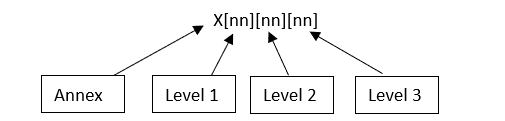
The X corresponds to the Annex under which a particular code is being produced which range from A to G. Following the Annex letter, the ‘nn’ terms serve as placeholders for numbers. Depending on the Annex, there are different numbers of levels for these annexes.
The more levels the Annex has, the more specific the final code would be. Level 01 features terms that are fairly general while the level 2 and level 3 terms are more specific, increase in descriptive power, and essentially branch out from level 1 terms.
In order to fully take advantage of the descriptive power of the codes, reporters are encouraged to make full use of these codes and report to the lowest level possible. Let us take the following scenario as an example: We need to report that a patient has suffered from anaemia resulting from the premature destruction of the peripheral red blood cells as a result of the adverse effects that the medical device had on the patient.
To describe the patient’s health condition, we use Annex E and navigate to the blood and the lymphatic system section. If one were to stop at this stage, they would be left with the following code:
E[03][nn][nn]
Delving deeper, one may choose the level 2 term that best describes this as A reduction in the number of red blood cells, the amount of hemoglobin, and/or the volume of packed red blood cells. This is under level 2 code 01. Furthermore, one may apply the level 03 code for Anemia resulting from the premature destruction of the peripheral blood red cells. This has the level 03 code of 01. Therefore, the final code is:
E[03][01][01]
Updating and Maintenance
Due to the rapidly evolving world of the medical device industry, new technologies, design procedures and materials are constantly emerging. It’s safe to assume that with this evolution in technology we will have more medical device problems and hence would need more terms to describe them adequately. It is therefore essential that the terms are updated in order to cater for this evolution in technology. This means that old obsolete terms must be removed and new ones must be added as required. The code features 2 digits per level in order to be future proof and make the required changes (adding or taking off) making the whole system developed by
Important Reference Documents
Please find a list of the important documents and websites that this article made reference to below:
- IMDRF Website; http://www.imdrf.org/index.asp
- IMDRF Document Page where the annexes are found in excel format; http://www.imdrf.org/documents/documents.asp

